
Rose Clay
Rose clay is a naturally occurring mineral clay that has been used quietly and consistently in personal care for generations. Historically, clays like this were valued not for novelty or dramatic claims, but for their availability, simplicity and adaptability. Their role was practical and understated — part of everyday routines rather than luxury rituals.
This page is part of the ASC Soapworks Ingredient Field Guide, a reference created to provide context around the ingredients used in our products.
What It Is
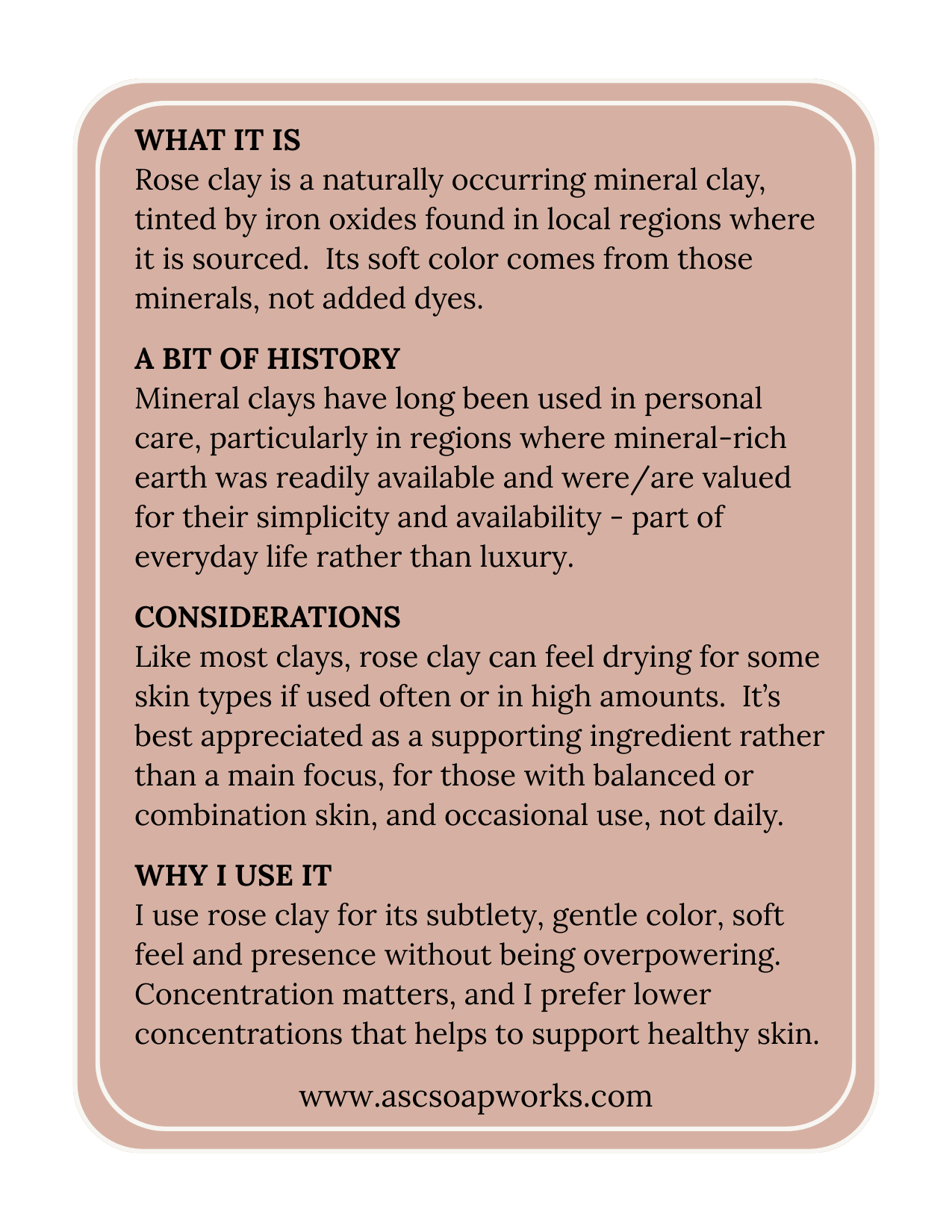
Rose clay is a naturally occurring mineral clay, typically sourced from regions rich in iron oxides. Its muted pink tone comes from the earth itself rather than added dyes, and it varies slightly depending on where it's found.
A Bit of History
Historically, clays like this were gathered locally and used in simple personal care routines. Their appeal wasn't tied to performance claims or trends, but to availability and ease of use — materials people understood and relied on as part of everyday life.
Considerations
In modern personal care, cosmetic clays are regulated rather than prohibited. In regions such as the United States, the European Union, the United Kingdom, Canada and Australia, clays are permitted for cosmetic use provided they meet established safety and purity standards. These regulations focus on sourcing, testing and allowable trace mineral levels, acknowledging that clays are natural materials while still holding finished products to strict safety thresholds.
Clays are sometimes described as "detoxifying," but that term can be misleading. True skin detoxification happens through the body's internal systems (think liver & kidneys), not through topical products. What clays can do is bind to surface-level impurities and oils present on the skin, allowing them to be rinsed away during use.
In formulations today, rose clay is often associated with gentler applications, but its value lies more in restraint than in results. Used thoughtfully, it adds subtle visual depth and a grounded feel without dominating a formula or the experience of using it.
As with most clays, rose clay can feel drying for some skin types if used frequently or in higher concentrations. For that reason, we treat it as a supporting ingredient — present, balanced and designed to complement the overall formulation rather than stand on its own.
In the Soap
At ASC Soapworks, rose clay is used sparingly and intentionally. The concentrations we use are low enough that the clay becomes fully incorporated into the soap batter and rarely carries through into the lather in a meaningful way. This helps avoid the messiness or staining that some people have experienced with clay-heavy products, particularly in light-colored or stone showers.
Why I Use It
When it comes to color, my preference is to work with ingredients that are as close to their original form as possible. I rely primarily on plant infusions and naturally occurring clays rather than synthetic dyes or lab-created colorants. I will choose a kaolin clay, water discount or salt/brine solution to provide a white contrast when needed. My understanding and process are constantly evolving, just as ingredient knowledge tends to deepen over time.
When organic plant material is available, plant infusions offer a simple, familiar way to introduce color — using the same kinds of materials people have historically worked with in everyday life, for centuries. Naturally occurring clays help fill in the gaps where plants don't reliably produce certain colors, allowing for gentle, mineral-based tones without relying on artificial pigments.
This approach isn't about purity or perfection, but intention. I choose materials that feel grounded, well-understood and appropriate for regular use — ingredients that support the overall integrity of a product rather than drawing attention to themselves.
Where You'll Find Rose Clay at ASC Soapworks
Rose clay appears in several ASC Soapworks soap bars, including:
- Some of our Limited Edition Bars — if you see pink or darker pink bordering on red, it's most likely rose clay
- Some of our Artisan Series Soap Bars — again, if you see pink or darker pink bordering on red, it's most likely rose clay
This page is part of the ongoing Ingredient Field Guide.
To explore other ingredients, return to the main guide: Ingredient Field Guide