
Lavender
Lavender is one of those ingredients that barely needs an introduction — and yet it deserves one anyway. Most people know lavender by its scent: familiar, calm, immediately recognizable. What's less often talked about is how that scent arrives, where it comes from, and what it actually means to use it intentionally in handmade soap.
At ASC Soapworks, lavender shows up in two forms: essential oil distilled from the flowering tops of Lavandula angustifolia, and dried buds used as a botanical presence on finished bars. They serve different purposes and behave differently in soap - and both are worth understanding.
This page is part of the ASC Soapworks Ingredient Field Guide, a reference created to provide context around the ingredients used in our products.
A Bit of History
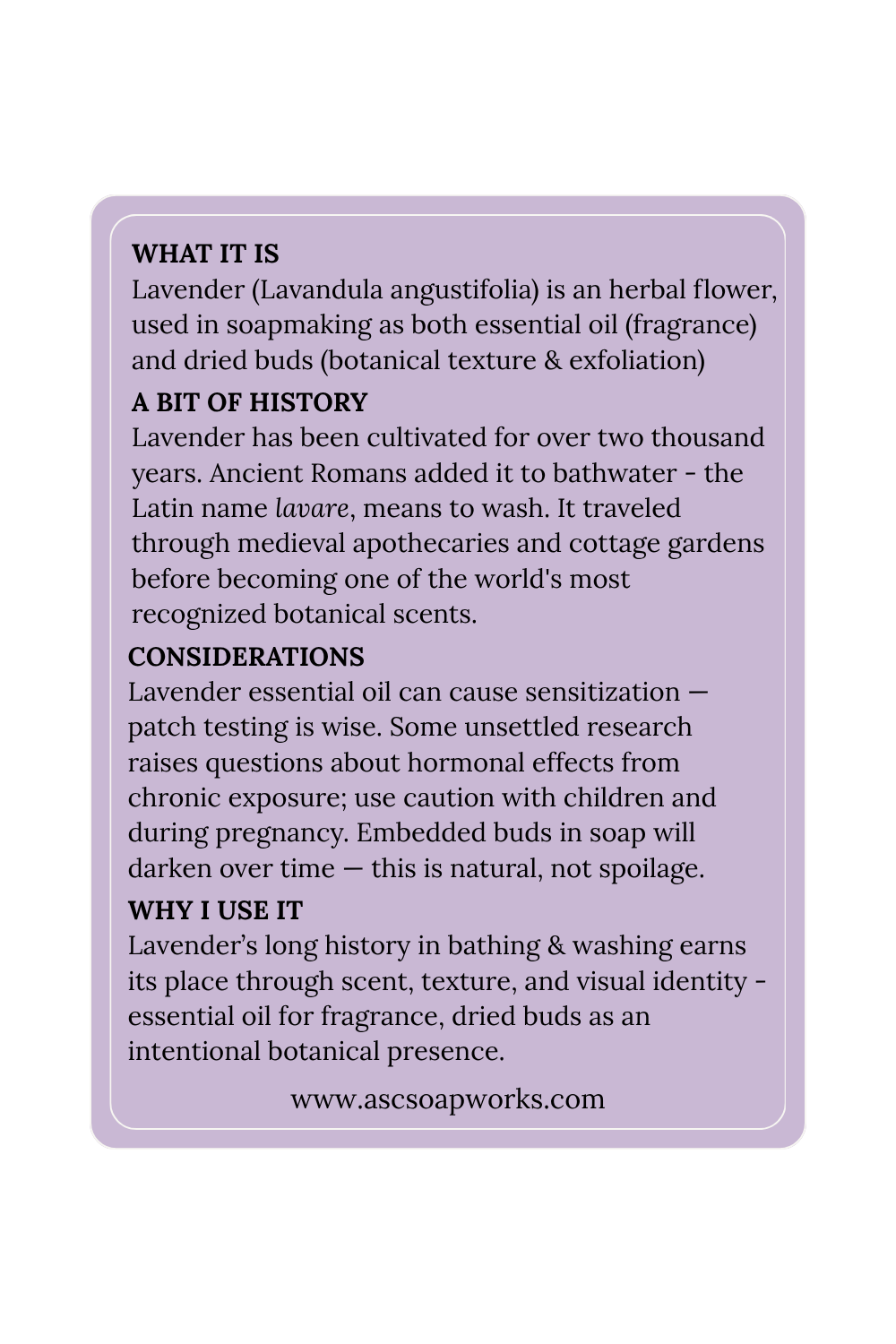
Lavender has been cultivated for more than two thousand years. The Romans added it to bathwater — the name itself likely traces back to the Latin lavare, meaning to wash. From there it moved through medieval apothecaries, where it was kept as a remedy and a preservative, into Ottoman distilleries, and eventually into the cottage gardens of England that shaped so much of how we think about botanical fragrance today. It arrived at our modern idea of "lavender scent" not through marketing but through sheer persistence — generation after generation finding it useful, pleasant and worth growing.
That kind of longevity doesn't happen by accident. Lavender is hardy, adaptable and produces an essential oil that holds its character well. It's not a delicate ingredient. It has staying power, and that's part of what makes it a natural anchor for a handmade soap collection.
In the Soap
Lavender essential oil is added at trace — the point when the soap batter has thickened enough to hold additions. It's one of the more well-behaved essential oils in cold process soapmaking: it doesn't accelerate trace dramatically, it doesn't discolor, and the scent carries reasonably well through cure.
The dried buds are a different story. Embedded in soap, they will darken — turning brown or nearly black over time as they react with the high-pH soap environment. This is purely cosmetic and completely normal. Buds placed on the surface of a bar and exposed to air hold their color longer, which is why you'll often see them used as a top decoration rather than mixed throughout. At ASC Soapworks, the buds are used intentionally and honestly — their eventual darkening is part of what they are, not something to hide.
Considerations
Lavender has a reputation as one of the gentler essential oils, and that reputation is mostly earned. But "mostly" is worth paying attention to. Lavender essential oil contains naturally occurring compounds — linalool and linalyl acetate among them — that can cause sensitization in some individuals, particularly with repeated or undiluted use. In finished soap, the concentration is significantly lower than in undiluted essential oil, but if you have known sensitivities to fragrance or essential oils, a patch test is always a reasonable first step.
There is also a body of research — contested and still evolving — that has raised questions about potential hormonal effects from chronic topical exposure to lavender essential oil, particularly in young children. The evidence is genuinely unsettled, and some of the original studies have been challenged on methodology. Extra caution for young children and during pregnancy seems reasonable given what's currently known.
It's worth noting that these questions apply far more broadly than lavender. Synthetic fragrance ingredients — including phthalates, parabens and synthetic musks commonly found in conventional soaps, lotions, candles and laundry products — carry a much more established body of concern around endocrine disruption, and many are not required to be individually listed on product labels. Choosing products scented with essential oils rather than synthetic fragrance is one of the more straightforward ways to reduce that particular exposure. It doesn't eliminate every question, as lavender itself shows — but it narrows the field considerably.
Ingredient knowledge evolves. The Ingredient Field Guide reflects what's currently understood, and we'll update it as the picture becomes clearer.
Why I Use It
Lavender earns its place across scent, texture and visual identity. The essential oil brings a fragrance that is real, recognizable and historically grounded — not an approximation of lavender, but lavender itself. The dried buds bring a visible botanical presence to finished bars that is honest and intentional.
Lavender has been used in washing and bathing for millennia. That quiet, persistent history is part of why it belongs here — not because it's trending, but because it has always been worth using.
Where You'll Find Lavender at ASC Soapworks
Lavender may currently be found in select ASC Soapworks soaps where a botanical liquid is a good fit for the overall formulation and design.
- Some of our Limited Edition Bars, currently the Lavender Bloom bar.
- Several of our Signature Series Bars — Lavender Mint, Lavender Rose, and Simply Lavender (with buds!). In addition, lavender is often added to other scent profiles to round out the experience — Stress Relief, for example.
- Bath Bombs — these are currently all scented with our stress relief scent blend.
- Shampoo Bar — our Rosemary & Lavender variety.
- Body Butter — Stress Relief Scent.
This page is part of the ongoing Ingredient Field Guide.
To explore other ingredients, return to the main guide: Ingredient Field Guide