
Calendula
Calendula is a flowering herb with a long history of use in traditional herbal preparations and personal care. Its bright yellow to orange petals are widely recognized, but its continued presence in skin-care products has less to do with appearance than with familiarity, availability and long-standing practical use. Like many well-established botanical ingredients, calendula has remained relevant not because it is novel, but because it is well known and widely understood.
This page is part of the ASC Soapworks Ingredient Field Guide, a reference created to provide context around the ingredients used in our products.
What It Is
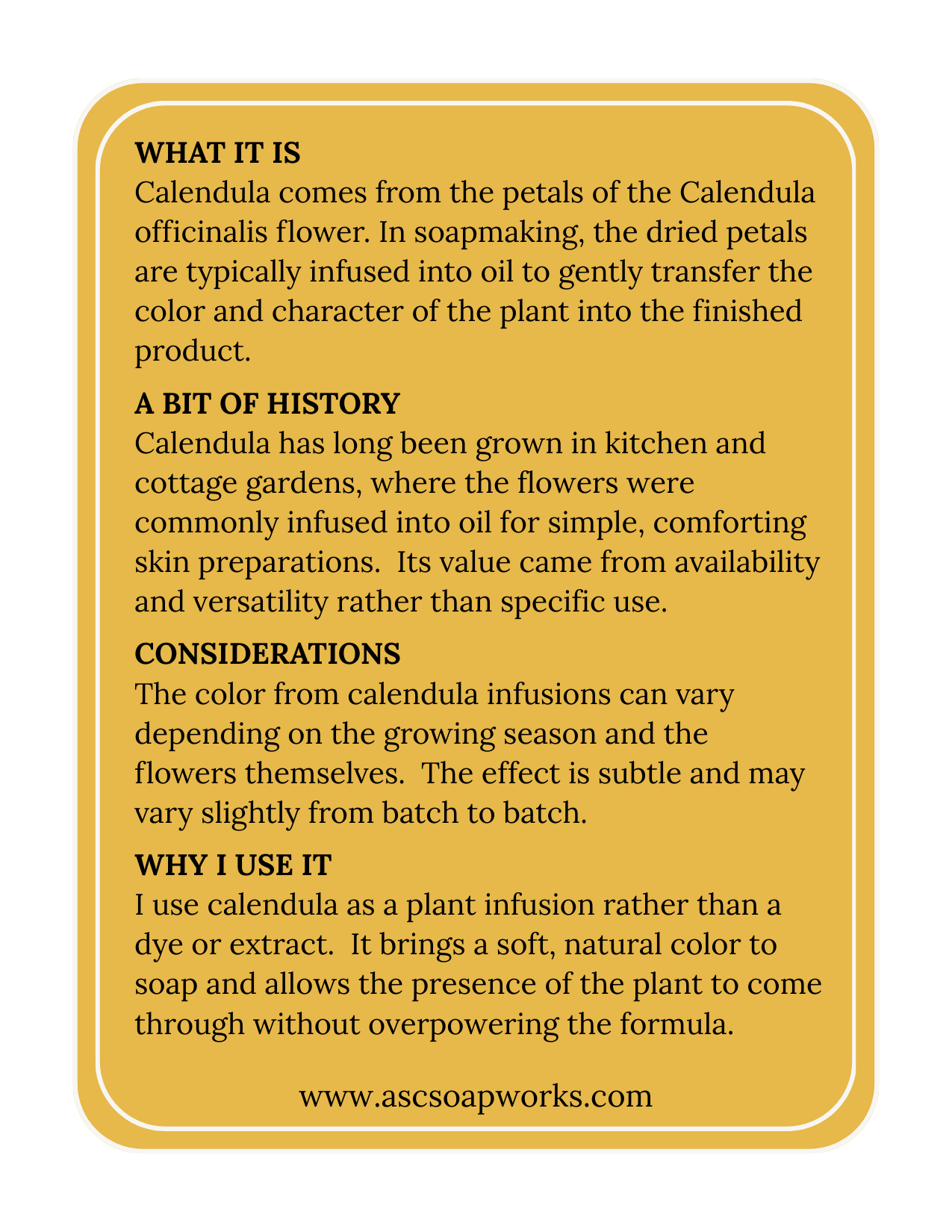
Calendula, often called pot marigold, is an herbaceous flowering plant distinct from the ornamental marigolds commonly grown for bedding color. In personal care, calendula is most often used as an infused botanical rather than as a direct functional additive. The petals are typically steeped in oil, allowing oil-soluble components of the plant material to be incorporated into soaps, balms and other body products.
Its appeal lies in both recognition and practicality. Calendula is widely grown, easy to identify and strongly associated with traditional home herbalism.
A Bit of History
Historically, calendula was used in simple household preparations in ways that did not require specialized equipment or complex processing. Dried petals could be infused into oil and incorporated into products intended for routine use. That accessibility is part of what has sustained calendula's place in personal care over time.
It also reflects a broader pattern found in many traditional ingredients: their value was often based on familiarity and ease of use rather than on dramatic claims. Calendula belongs to that category of practical botanical materials that have remained in use because they were both available and workable.
Considerations
In modern personal care, calendula is commonly used in infused oils, soaps, balms, salves and related products. Its appeal is often tied to its botanical identity and historical association with skin-care preparations.
At the same time, calendula is a good example of how traditional ingredients can accumulate exaggerated marketing language over time. At ASC Soapworks, I prefer to describe it in more measured terms. Calendula has a well-established place in herbal and cosmetic traditions, and that context is meaningful without overstatement.
In the Soap
In soap and body care, calendula is generally used for the character it brings to a formulation rather than for a dramatic functional effect. A calendula-infused oil may be incorporated into the base recipe, while petals can sometimes be used for visual detail or botanical interest depending on the product design.
From a formulation standpoint, it fits well within a small-batch approach because it is straightforward, recognizable and compatible with a more traditional ingredient palette. It supports the overall composition of a product without dominating it.
Why I Use It
I am drawn to ingredients like calendula because they are established, understandable and appropriate for everyday products. I'm less interested in ingredients chosen mainly for trend value and more interested in materials that have a clear historical and practical place in personal care.
Calendula fits that approach well. It contributes a botanical element that feels consistent with the kind of products I want ASC Soapworks to make: thoughtful, grounded and built around ingredients that make sense both in formulation and in everyday use.
Where You'll Find Calendula at ASC Soapworks
Calendula may currently be found in select ASC Soapworks soaps and body products where an infused botanical ingredient is a good fit for the overall formulation and design.
- Some of our Limited Edition Bars, currently the Calendula Pot bar.
- Look for other body products like balms, coming soon!
This page is part of the ongoing Ingredient Field Guide.
To explore other ingredients, return to the main guide: Ingredient Field Guide